
Functions – 35 course points
This assignment consists of three parts. First, write a library of static methods that performs geometric transforms on polygons.
Refer to our Programming Assignments FAQ for instructions on how to install VSCode, how to use the command line and how to submit your assignments.
Start your assignment early.
Programming
Write 1 programs and submit on Autolab.
We provide this ZIP FILE containing PolygonTransform.java.
Observe the following rules:
- DO NOT use System.exit().
- DO NOT add the project or package statements.
- DO NOT change the class name.
- DO NOT change the headers of ANY of the given methods.
- DO NOT add any new class fields.
- ONLY display the result as specified by the example for each problem.
- DO NOT print other messages, follow the examples for each problem.
- USE StdIn, StdOut, StdRandom, and StdDraw libraries.
Polygon transform (25 points). Write a library of static methods that performs various geometric transforms on polygons. Mathematically, a polygon is defined by its sequence of vertices (x0, y 0), (x 1, y 1), (x 2, y 2), …. In Java, we will represent a polygon by storing the x– and y-coordinates of the vertices in two parallel arrays x[] and y[].
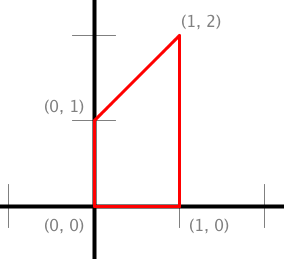
// Represents the polygon with vertices (0, 0), (1, 0), (1, 2), (0, 1).
double x[] = { 0, 1, 1, 0 };
double y[] = { 0, 0, 2, 1 };
Three useful geometric transforms are scale, translate and rotate.
- Scale the coordinates of each vertex (x i, y i) by a factor α.
- x‘i = α xi
- y‘i = α yi
- Translate each vertex (x i, y i) by a given offset (dx, dy).
- x‘i = xi + dx
- y‘i = yi + dy
- Rotate each vertex (x i, y i) by θ degrees counterclockwise, around the origin.
- x‘i = xi cos θ – yi sin θ
- y‘i = yi cos θ + xi sin θ
(Hint: Know the difference between degrees and radians. Know what Java uses for parameters to the sin and cos functions and perhaps google “Java Math.toRadians” and “Java Math.toDegrees” )
Write a two-dimensional transformation library by implementing the following API:
public class PolygonTransform {

   // Returns a new array object that is an exact copy of the given array.
   // The given array is not mutated.
   public static double[] copy(double[] array)

   // Scales the polygon by the factor alpha.
   public static void scale(double[] x, double[] y, double alpha)

   // Translates the polygon by (dx, dy).
   public static void translate(double[] x, double[] y, double dx, double dy)

   // Rotates the polygon theta degrees counterclockwise, about the origin.
   public static void rotate(double[] x, double[] y, double theta)

   // Tests each of the API methods by directly calling them.
   public static void main(String[] args)
}
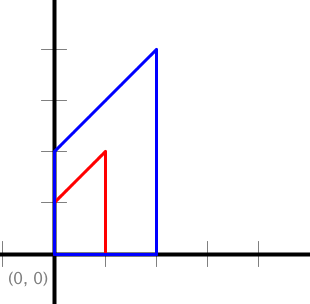
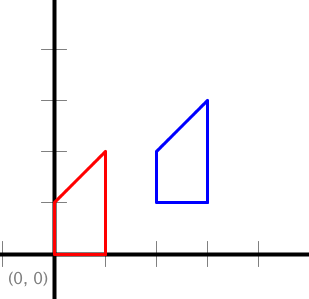
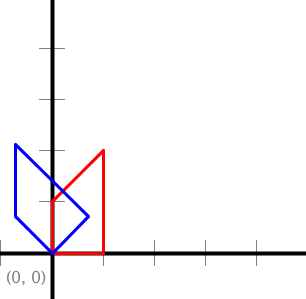
Note that the transformation methods scale(), translate() and rotate() mutate the polygons. Here are some example test cases (tests for copy() are not shown):
// Scales polygon by the factor 2.
StdDraw.setScale(-5.0, +5.0);
double[] x = { 0, 1, 1, 0 };
double[] y = { 0, 0, 2, 1 };
double alpha = 2.0;
StdDraw.setPenColor(StdDraw.RED);
StdDraw.polygon(x, y);
scale(x, y, alpha);
StdDraw.setPenColor(StdDraw.BLUE);
StdDraw.polygon(x, y);
// Translates polygon by (2, 1).
StdDraw.setScale(-5.0, +5.0);
double[] x = { 0, 1, 1, 0 };
double[] y = { 0, 0, 2, 1 };
double dx = 2.0, dy = 1.0;
StdDraw.setPenColor(StdDraw.RED);
StdDraw.polygon(x, y);
translate(x, y, dx, dy);
StdDraw.setPenColor(StdDraw.BLUE);
StdDraw.polygon(x, y);
// Rotates polygon 45 degrees.
StdDraw.setScale(-5.0, +5.0);
double[] x = { 0, 1, 1, 0 };
double[] y = { 0, 0, 2, 1 };
double theta = 45.0;
StdDraw.setPenColor(StdDraw.RED);
StdDraw.polygon(x, y);
rotate(x, y, theta);
StdDraw.setPenColor(StdDraw.BLUE);
StdDraw.polygon(x, y);
Before submission
- Collaboration policy. Read our collaboration policy here.
- Update @author. Update the @author tag of the files with your name, email and netid.
- Submitting the assignment. Submit PolygonTransform.java via the web submission system called Autolab. To do this, click the Assignments link from the course website; click the Submit link for that assignment.
Getting help
If anything is unclear, don’t hesitate to drop by office hours or post a question on Piazza. Find instructors office hours by clicking the Staff link from the course website. In addition to office hours we have the CAVE (Collaborative Academic Versatile Environment), a community space staffed with lab assistants which are undergraduate students further along the CS major to answer questions.
Problems by Kevin Wayne and Alan Kaplan.
